Analysis · Blog
Crypto Hash Gambling and the Evidence Behind Its Rise
Blockchain outcomes can be checked. The size of the business is much harder to establish.
Tested & written by CalderCashout · CryptoCasino.ReportTap for more +Tap to close ×
CalderCashout · the reviewer on a team of three, pseudonymous on purpose. The money is public. Our names aren't.
I run every page here the same way: deposit first, write second. I send my own crypto, play, request the withdrawal, log the timestamps and the transaction hashes, and only then write. Nothing here is a rewrite of a casino's press kit or somebody else's list.
My ledgernet −13.68 USDT · 0.00061719 BTC in play
Withdrew 56.1 USDT from BitStarz
Six minutes after I confirmed the new address · gas paid by BitStarztx 0x82b16902…aed554e ↗Lost $8.66 at BitStarz
$1.24 of it canceling the welcome bonusDeposited 15 USDT at BitStarz
To get back over the $50 withdrawal minimumtx 0x4c151f3c…bf71757 ↗
A $51 billion gambling market is bound to grab attention. However, there's a problem with calling it a hash-betting boom: it's not clear how much of that money actually comes from hash-based games. The figure, reported by TRM Labs for 2025, covers a much wider range of on-chain gambling activity, the kind tracked in our crypto gambling statistics.
Hash gambling itself is nothing new. Some games use blockchain block identifiers to decide whether a bet wins or loses. Others combine transaction data with hidden values to generate results. And while conventional provably fair casinos also rely on cryptographic hashes, their games don't necessarily run on a blockchain.
Lumping all of these together risks making hash betting look like a bigger, more established market than the evidence supports. The more interesting story lies in how these games operate: fast bets, low distribution costs, and a claim of transparency that isn't always as straightforward as it sounds.
Blockchain-hash betting is an established form of crypto gambling, but the public evidence examined here does not establish a separate global market size or a comparable 2022–2026 growth rate. Broader gambling activity has expanded. How much of that expansion belongs to hash-settled games remains unresolved.
At a glance
- The word hash can refer to a payment receipt, an input to a betting result, or a commitment to a secret. These are different functions.
- Historical operator records document address-based Bitcoin gambling in 2012 and TRON block-hash games in 2022.
- Broad gambling totals do not isolate games whose outcomes depend on blockchain hashes.
- Published betting probabilities can be checked against the actual outcome rule, rather than accepted as part of a fairness claim.
- Deposits, total stakes, withdrawals, and casino revenue measure different things.
- Reproducing a result does not establish the operator’s solvency, licensing, or willingness to pay.
What crypto hash gambling actually means
Blockchain-hash betting means a game in which a specified transaction hash or block identifier contributes directly to the outcome. A rule might classify a digit as odd or even, add several values, or map selected characters to a lottery result.
Beosin’s 2025 virtual-asset AML report describes this format, including outcomes based on parity, digit sums, and combinations of numbers and letters. It identifies a mechanism, rather than a standardized market category.
The word hash has three distinct jobs in these products.
| Use of a hash | What it does | What it establishes |
|---|---|---|
| Payment transaction identifier | Identifies a recorded transfer | Evidence about that transfer, rather than the game’s result |
| Blockchain input to a game | Supplies a value used by the published outcome rule | Allows the result to be reproduced when the selected input and full rule are known; does not prove unbiased input selection |
| Commitment to a server seed | Lets a player later check that a revealed secret matches an earlier commitment | Allows a revealed secret to be checked against the earlier commitment; does not prove how the secret was chosen |
Stake’s published implementation, for example, uses a server seed, client seed, nonce, and cursor with HMAC-SHA256 to generate game data. It is called a cryptographic verification system. The described inputs are not a future blockchain block hash.
HASHFUN’s product descriptions use a different model: a future block height is fixed, then a block-hash digit determines a result. Its catalog applies hash-based mechanics to number predictions, lottery formats, and other casino-style games. These are operator descriptions, not independently audited performance claims.
TRON’s documentation also uses block ID for a composite value containing a block-number prefix and a SHA-256-derived suffix. Selecting particular suffix characters is more specific than simply saying a game uses the block hash.
The same game names can therefore conceal different technical systems. Dice, baccarat, or a lottery label tells you less than the rule specifying the input, the betting cutoff, and the calculation.
The history reaches further back than the current branding
SatoshiDICE’s original Bitcoin Forum thread dates to 24 April 2012. An operator update reported more than 1.5 million bets by November that year. This is a historical self-report about bets, not an audited count of players or a current platform statistic.
The same thread records an early question about cryptographic assurance. Could the operator choose which day’s secret applied to a transaction near a cutoff? The operator acknowledged that discretion was possible. The exchange documents a design concern, rather than evidence that a particular bet was manipulated.
The underlying question still exists: who fixes the inputs, and when does that decision become irreversible?
| Date | Documented evidence | What it supports |
|---|---|---|
| April 2012 | SatoshiDICE’s original operator thread | Address-based crypto wagering predates recent HashFi branding |
| September 2019 | SlowMist’s EOS Play incident analysis | Blockchain-derived randomness had already produced practical security problems |
| July 2022 | OBHash’s published TRON game rules | A documented example of block-hash betting during the requested research period |
| June 2026 | TRM’s broader gambling research | Sector context, without a separate hash-only growth series |
The growth figures describe a broader business
TRM Labs reported $51 billion in on-chain gambling volume for 2025, $15 billion for Q4 2025 and $14 billion for Q1 2026. Its measure is proportional to incoming volume to addresses classified as gambling across eight blockchains. These are broad gambling flows, not a hash-only total or a ledger of every game’s stakes. Q1 was also below the preceding quarter.
TRM’s January 2022–March 2026 personal-wallet analysis found that 6.3% of wallets accounted for 91.8% of that sample’s volume. Wallets are not unique people, and this sample differs from the wider sector total. Concentrated funding can grow without comparable growth in player numbers.
How much of that activity reached games using blockchain hashes as outcome inputs? Did that share rise? The report does not supply a separate series that answers those questions.
The distinction matters because a centralized casino can receive one on-chain deposit and then run thousands of rounds on a private ledger. A smart-contract game may expose individual bets publicly. Their blockchain records reveal different parts of the business.
For a meaningful comparison, the definition of hash betting, operator list, chain coverage, and counting method must stay consistent across periods.
Fast rounds and referral rewards help explain the appeal
A compact outcome rule fits a small screen. A wallet can handle payment, while a blockchain reference gives the player something to inspect afterward. That makes the product easy to demonstrate.
TRON normally schedules a block-production slot every three seconds. Missed slots, maintenance, and network delays can extend the interval. The schedule makes short rounds technically possible; it does not guarantee a game’s settlement or withdrawal time.
Stablecoin-denominated bets are also easier to read without converting a volatile token price. Issuer, network, custody, and operator risks remain. This is an explanation of convenience, rather than evidence of adoption.
The distribution evidence is more concrete. OBHash’s July 2022 referral page advertised commissions of up to 1% from referred users’ winnings and a conditional offer covering losses in the first five rounds. It told users to share referral links through social apps. Those were advertised incentives; their payment was not verified.
Simple mechanics and shareable incentives offer an explanation for visibility. Establishing sustained demand would require activity and retention data.
Checking the mathematics behind a 50 percent claim
OBHash’s July 2022 Lucky Draw guide advertised a 50% win chance. Its rule paid 2x the stake when the final two block-hash characters contained one digit and one letter, in either order.
Assume those characters are independent and uniformly distributed hexadecimal symbols: ten digits, 0–9, and six letters, a–f. Of 256 ordered pairs, 120 contain one of each. The win probability is therefore 46.875%. With a total payout of 2x the stake on a win and zero on a loss, theoretical return to player is 93.75%, leaving a 6.25% house edge before fees.
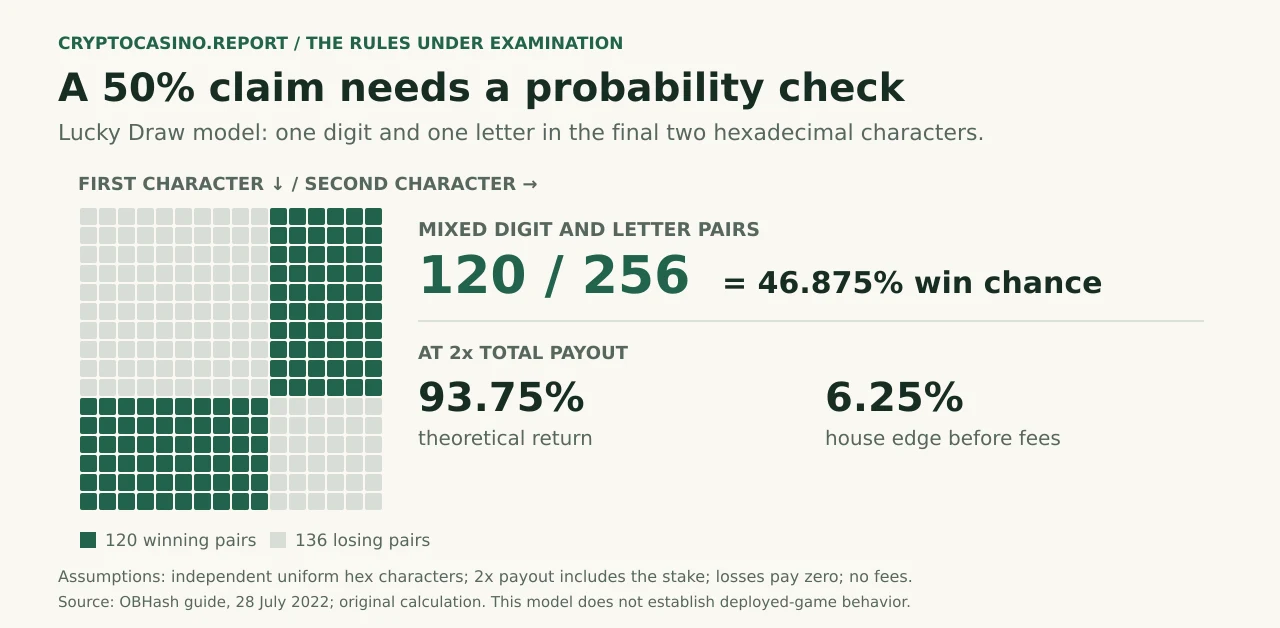
This calculation tests the historical description under stated assumptions. The guide also shows non-hexadecimal letters in examples, so it is not a precise specification of implemented input handling. Different extraction or distribution rules could change the result. No deployed code or payments were audited here. Under this model, the advertised 50% does not follow.
The same balance can generate repeated betting turnover
Suppose someone deposits $100 and completes 100 rounds at $5 per bet, reusing the remaining balance and any winnings. Provided the balance lasts, that session records $500 in stakes from a $100 deposit. It is an illustration, not operator data.
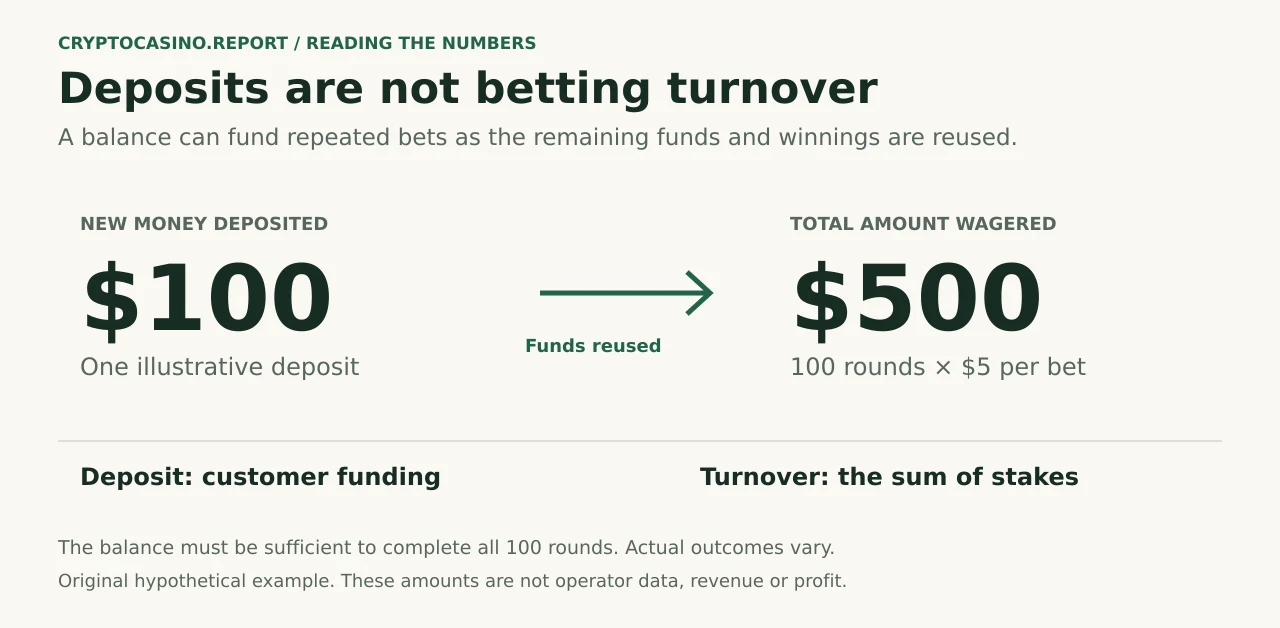
Withdrawals and redeposits can make the same funds appear repeatedly in incoming-volume totals. Treasury transfers can add movement that is not customer betting. Whether a dataset excludes those flows depends on its method.
The Gambling Commission’s live-RTP terminology includes reinvested winnings in turnover. Its gross gambling yield definition counts relevant receipts less prizes or winnings. Neither measure is interchangeable with deposits or net profit.
| Metric | What it measures | What it cannot establish alone |
|---|---|---|
| Deposits | Funds arriving at identified customer-funding addresses | Total stakes, unique people, or operator revenue |
| Withdrawals | Funds paid out from identified addresses | Whether every valid withdrawal request was honored |
| Stakes or turnover | Amount wagered, including reused balances | The amount of new money deposited |
| Gross gambling yield | Relevant receipts less prizes or winnings | Net profit after operating expenses |
| Wallet balance | Assets visible at a particular address and time | All liabilities, control of other wallets, or solvency |
A large volume-to-wallet ratio could reflect repeat betting, high-value users, automation or a counting problem. The ratio alone cannot establish fabricated demand.
Fast rounds also allow more bets within a session. In a simplified model with fixed $1 stakes and a 2.5% house edge, 100 completed bets generate $2.50 in expected gross gaming return for the house; 1,000 generate $25.
Those are expected values, not guaranteed profits or predictions for a session. Actual outcomes, fees, incentives and operating costs change the result.
A public hash can still be a poor source of randomness
A hash is deterministic: the same input produces the same output. Its suitability for gambling depends on what an interested party can know or influence before the bet becomes binding.
TRON’s transaction ID is a SHA-256 hash of serialized transaction data and is available before broadcast. It is not automatically an unknowable future event. A game that uses it as randomness must account for the sender’s knowledge of and control over the inputs.
Future-block designs face another set of questions. Who selects the block? Is the selection fixed before bets close? Can a party delay settlement, change the reference, or discard an unfavorable result? What influence do block producers have under that chain’s consensus rules?
Chainlink’s VRF guidance illustrates why implementation matters even with a dedicated randomness service. It addresses request ordering, confirmation depth, input cutoffs, and the risk of discarding unfavorable results through cancellations or re-requests. These are design checks, rather than allegations about the operators discussed here.
SlowMist’s analysis of the September 2019 EOS Play incident described an attack involving network-resource economics and game randomness. It concerned a specific historical EOS implementation. It does not establish that every block-based game has the same flaw.
To assess a fairness claim, follow the whole sequence: the binding bet, fixed input-selection rule, randomness model, conversion and settlement. A hash displayed on a screen documents only part of it.
Verifying a result does not verify the operator
A game can calculate a result correctly while maintaining inadequate reserves, restrictive withdrawal terms, or excessive administrator powers. The calculation also says nothing about gambling authorization.
Ethereum’s documentation distinguishes source-code verification from security review. Matching source to deployed bytecode helps establish what code is running. An audit examines a wider set of weaknesses, but cannot eliminate every vulnerability.
Custody requires its own investigation. Can an administrator move the bankroll, pause payments, change an implementation, or alter the rules for future rounds? A public wallet balance answers none of those questions on its own.
Licensing requires a match between the legal entity, domain, permitted activity, jurisdiction, and current register entry. A footer badge is insufficient. Great Britain’s Gambling Commission register is one example of a jurisdiction-specific checking route; it does not establish permission elsewhere.
This review does not establish the licensing status of OBHash or HASHFUN, and neither is recommended here. Historical product documentation is useful evidence of a mechanism, not a basis for trusting an operator with funds.
Speed increases the importance of player protection
Short cycles create more betting decisions within a session and can make repeated losses easier to accumulate.
The Gambling Commission identifies speed and frequency as factors in gambling harm, including loss chasing. This is broader product-risk guidance, rather than a prevalence study of hash betting.
A game promoting rapid rounds should also be examined for deposit limits, session reminders, self-exclusion, and accessible dispute handling. Those protections deserve scrutiny alongside the verifier.
A previous loss does not improve the next round’s odds in an independent-outcome model. If gambling is causing harm, stop and seek local gambling-support services. Our responsible gambling page lists free help.
What a credible growth claim needs to show
A credible growth claim would define the games included and publish an operator or contract list with comparable activity across multiple periods.
It would distinguish first-time funding from repeat funding, customer transfers from internal movements, and deposits from stakes. Its treatment of bots, multiple wallets, chain coverage, and US-dollar valuation would need to be disclosed.
For off-chain games, a blockchain explorer cannot reconstruct a private betting ledger from deposit history. Operator records and independent assurance would be needed to reconcile the missing activity.
The sources reviewed here do not provide a complete hash-only growth series for 2022–2026 or a reliable ranking by current users. They document products and incentives more clearly than the segment’s size.
Hash betting gives readers a concrete mechanism to examine. The next step is evidence that connects those games to measured activity over time. Until then, growth in broader crypto gambling should keep its broader label.
How to check the claims yourself
The checks below use public records and calculations. They do not require placing a bet or connecting a wallet.
| Question | Useful check |
|---|---|
| Which hash determines the result | Read the exact transaction, block-selection, or seed rule; identify when it becomes binding |
| Do the advertised odds follow | Enumerate the possible outcomes and apply the payout schedule, including fees and exceptional cases |
| Is a payment recorded | Use the correct network explorer to inspect token, amount, sender, recipient, status, and time |
| Does the source match the deployed contract | Compare the network and contract address with verified source; inspect upgrade and administrative controls |
| Is a growth figure comparable | Record the period, chain coverage, address-labeling method, and whether it measures deposits or stakes |
| Is the service authorized | Match its legal entity and domain against the relevant regulator’s current register |
Start with the dated rules and technical documents. Reproduce the probability calculation with its assumptions attached. A recorded transfer can establish a payment; one payment cannot establish overall withdrawal reliability.
CryptoCasino.Report’s grading criteria separate fairness from cash-out, licensing, and support. Its license tracker and transaction ledger provide the same useful separation for the casinos it covers.
Quick answers
Is crypto hash gambling the same as provably fair gambling?
The categories overlap. Blockchain-hash games use a chain-derived value in the outcome. Other provably fair games use committed server seeds and player inputs. A payment transaction hash alone establishes neither system.
Can a hash betting result be manipulated?
It depends on input control, block selection, betting cutoffs, settlement discretion and chain security. A calculation can reproduce correctly even when an earlier selection step is vulnerable.
Is there a verified global market size for hash gambling?
The sources reviewed here do not establish a separate, reproducible global estimate. Broad crypto-gambling figures should retain their original category and measurement definition.
Does a verifiable game guarantee withdrawals?
No. Reproducing a result does not establish custody arrangements, solvency or the payment of every valid withdrawal request.
Research scope and limitations
This article uses dated operator materials, blockchain documentation, security research, regulator publications and a commercial analytics report. Historical operator statements establish what was advertised, rather than independently verified performance.
The probability and turnover examples are original calculations with explicit assumptions. No live bets, withdrawal tests or deployed-contract audits were performed. No complete on-chain activity dataset was independently aggregated, and no current address-level activity totals are presented.
TRM, Beosin and SlowMist sell analytics or security services; operators have a commercial interest in their descriptions. Historical forum posts may have been edited. These limitations affect what each source can establish.
Sources
Every figure above traces to one of these.
- TRM Labs, Gambling is One of Crypto’s Fastest-growing Sectorstrmlabs.com · Published 10 June 2026. Broader gambling activity, wallet concentration, and methodology.
- Beosin, 2025 Virtual Asset AML Annual Reportbeosin.com · PDF page 35. Definition and examples of blockchain-hash gambling; no separate segment total used.
- Stake, Provably Fair Implementationstake.com · Technical comparator for seed-based HMAC-SHA256 outcomes.
- HASHFUN, Product and services descriptionshashfun.io · Retrieved operator descriptions of future-block games, leasing, and development. Direct page retrieval failed; indexed text was available. Claims were not audited.
- Bitcoin Forum, Original SatoshiDICE operator threadbitcointalk.org · Thread opened 24 April 2012; opening post updated in November 2012. Historical self-report and secret-selection discussion.
- OBHash, Guide to its hash gamesobhash.medium.com · Published 28 July 2022. Historical rules underlying the conditional probability calculation.
- OBHash, Referral commission rulesobhash.medium.com · Published 30 July 2022. Evidence of advertised acquisition incentives.
- TRON Developer Hub, Blocksdevelopers.tron.network · Block-ID structure and normal production schedule. The ID has a block-number prefix and a SHA-256-derived suffix.
- TRON Developer Hub, Sign and broadcast the API workflowdevelopers.tron.network · , with encoding documentation. Transaction-ID construction and availability before broadcast.
- Chainlink, VRF Security Considerationsdocs.chain.link · Randomness-request ordering, confirmations, input cutoffs, and cancellation risks.
- SlowMist, Details of a new type random number attack on EOSslowmist.medium.com · Published 1 October 2019; concerns the 14 September 2019 EOS Play incident and a specific historical EOS implementation.
- Gambling Commission, Stake leaving the GB marketgamblingcommission.gov.uk · Published 12 February 2025. Domain- and operator-specific regulatory example.
- Gambling Commission, Higher risk productsgamblingcommission.gov.uk · Guidance on speed, frequency, and harm.
- Ethereum.org, Verifying smart contractsethereum.org · Source-code and bytecode verification.
- Ethereum.org, Smart contract securityethereum.org · Security-review methods and audit limitations.
- UNODC, Casinos Money Laundering Underground Banking and Transnational Organized Crime in East and Southeast Asiaunodc.org · Regional context; not a hash-betting market estimate.
- Gambling Commission, Definitions of termsgamblingcommission.gov.uk · Gross gambling yield definition.
- Gambling Commission, Key terms for live RTP monitoringgamblingcommission.gov.uk · Turnover includes reinvested winnings.